Imperial Ultracold Strontium Lab | Atom Interferometer Observatory and Network (AION)
This is the website for the Ultracold Strontium Lab at Imperial, which leads the UK’s AION collaboration (see our collaborators list).
We founded the Ultracold Strontium Lab and the Atom Interferometer Observatory and Network (AION) in 2021, driven by the goal to search for Ultra-Light Dark Matter and Gravitational Waves using clock-transition atom interferometry. In the lab we create interference between wave-packets of laser-cooled strontium atoms, split and recombined using the ultranarrow 1S0 to 3P0 transition — the same transition used to build the world’s most precise atomic clocks. We plan to scale this technology to a larger facility, with atom interferometers separated by ≫ 100 m (e.g. the AICE facility), ultimately hoping to see small wobbles in the relative phase of the interferometers due to passing gravitational waves or dark matter fields (see Figure 1).
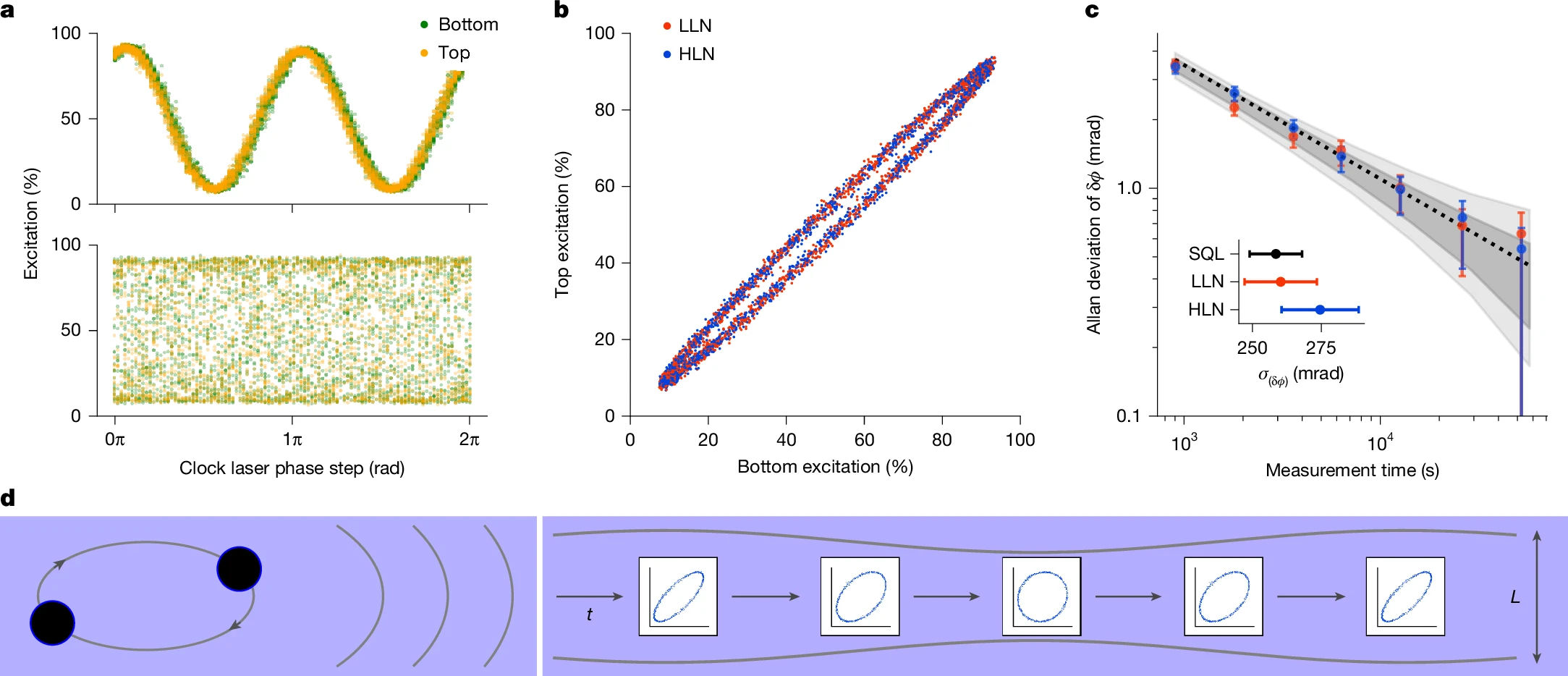
In 2026, we demonstrated the first prototype clock-transition atom-interferometer detector at the lab scale [Nature 654, 622–628 (2026)]. Since then, we have demonstrated a record-high-flux source of cold strontium atoms [AVS Quantum Sci. 8, 033201 (2026)]. We are currently working towards Large Momentum Transfer (LMT), cavity-based squeezing, and continuous ultracold-atom sources – three techniques to improve the sensitivity of the detector.
News
-
October 04, 2026
Welcome Thomas and Nora!
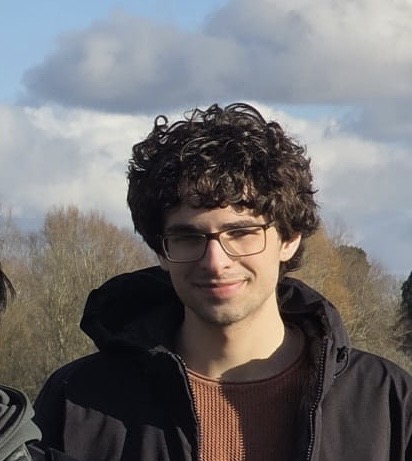
With the start of the new academic year, we welcome Thomas Accattatis who will be joining us as a new PhD student and Nora Malgeri who will be conducting the research phase of her Masters in Physics here at Imperial in the Ultracold Strontium Lab!
Read more » -
August 01, 2026
Goodbye Charles!
It is with much sadness that we announce the departure of Dr. Charles Baynham from the AION experiment and the Ultracold Strontium Lab at Imperial. He will be heading to IonQ where he will help lead the effort to develop trapped-ion based quantum computers.
Read more » -
July 01, 2026
New UROP students Leo and Xander
We are happy to include Leo Bessonov and Xander Cooke to our group as the latest UROP students. Leo rejoins us from the UROP project he did with us last year and we welcome Xander from Oxford where the two of them will be researching how to use ARTIQ to control a spatial light modulator to control laser beams for the purposes of neutral atom quantum computation or other exciting applications!
Read more » -
June 08, 2026
Differential clock interferometry in the Imperial AION system
We are proud to present our latest work, just published in Nature, demonstrating noise rejection in a differential atom interferometer using the strontium-87 clock transition. This is an important step towards the long-baseline atom interferometer AION needs to search for gravitational waves and dark matter, validating the principle of laser noise rejection between two separated interferometers.
Read more »
-
June 03, 2026
Elizabeth Pasatembou Graduated!
We are super proud of our very first PhD graduate, Dr. Elizabeth Pasatembou, who has graduated from her degree and is now working in quantum key distribution in Cyprus. Well done Elizabeth!
Read more »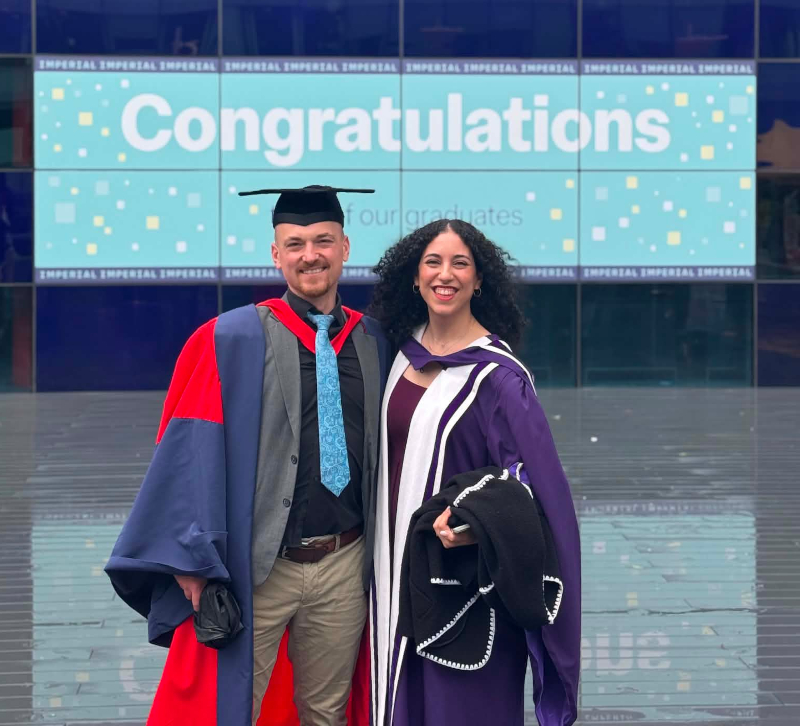
-
June 01, 2026
The Bait with Adelaide Aronio
We were lucky enough to work with the amazing artist Adelaide Aronio who has produce a series of art works and a murial inspired by our search for dark matter. Visit her website to see more beautiful examples.
Read more »
-
March 31, 2025
ARTIQ training 2025
Another year, another ARTIQ training course! This year we hosted a fantastic group of 24 quantum researchers coming from Birmingham, Cambridge, Kings College London, Oxford, the Rutherford Appleton Laboratory, Durham, the National Quantum Computing Centre, and the National Physical Laboratory. The course was in-person at Imperial College where we programmed two Sinara systems live and learnt the concepts of quantum control with ARTIQ.
Read more »
-
February 28, 2024
PhD opening in the AION group
We have a funded position for a PhD student starting in 2024 to join the AION group at Imperial!
Read more »
Research

Ultra-precise, shock-resistant optical clocks
Learn about the USOC project to develop ultra-precise, shock-resistant optical clocks using a continuous stream of ultracold strontium atoms in a moving optical lattice


The vision for AION
Read about our latest work on clock-transition atom interferomtry, published in Nature


The vision for AION
Learn more about the core vision of AION: a 4-stage project aiming to build gravitaional wave and dark matter detectors at the km-scale using cutting-edge techniques from quantum science.

The AION Physics Case in a Nutshell
The physics case for AION - our proposed sensitivity to dark matter and gravitational waves explained.
People
Principle Investigators
Dr. Richard Hobson
Prof. Oliver Buchmueller
Collaborators


Doctoral Students
Masters Students