
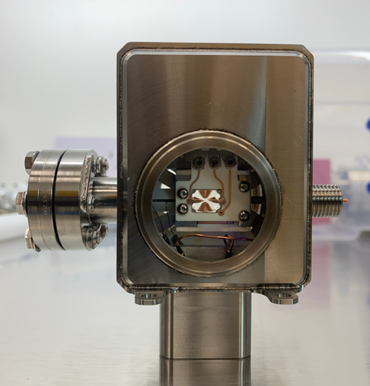
We have a funded position for a PhD student starting in 2026 for a PhD student to build portable optical atomic clocks. You will be working with us and our partner at the UK’s National Physical Laboratory in Teddington, Dr. Sean Mulholland.
Optical atomic clocks (OACs) represent the pinnacle of measurement technology, and their extreme accuracy unlocks new opportunities in fundamental physics and technology - from detecting dark matter and relativistic geodesy to improving satellite navigation. However, the scientific and technological impact of current-generation OACs has been limited, as they are typically fragile, laboratory-sized systems. New approaches are required to make OACs rugged, transportable and unlock their potential. A near term application of transportable OACs is to conduct frequency intercomparisons with OACs at other institutes to support the redefinition of the SI second to a new definition based on OACs.
In this project you will:
- Apply atomic physics with ion trapping, optics and laser technology to create a quantum technology with immediate real-world impact
- Work at the UK National Physical Laboratory to contribute to the international effort to redefine the SI second, realisable with higher accuracy based on optical atomic clocks
- Bridge theory, precision measurement and engineering to build a portable OAC with trapped strontium ions
- Deploy the transportable OAC in international institutes or in field applications
For more information please contact Charles Baynham or, to apply, visit the Matter community page at https://www.imperial.ac.uk/physics/research/communities/matter/phd-opportunities/.